
 For most of us, nudity isn’t something we experience – it’s something we’re shown.
On red carpets. In movies. On social media. Always styled, always intentional, always meant to be seen. It’s no wonder we start to think that’s what nudity is.
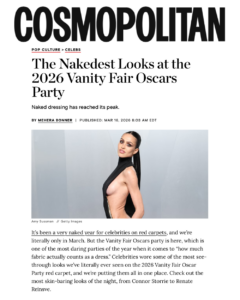
At this year’s Oscars – and throughout awards season – “naked dressing” has been everywhere. Sheer fabrics. Strategic cutouts. Dresses designed to look like bare skin while still controlling exactly what is seen. Coverage of the Vanity Fair Oscars after-party has highlighted just how dominant and daring the trend has become (see Cosmopolitan, “Vanity Fair Oscar Party Naked Dresses,” 2026).
It might feel like a modern trend, driven by social media and the pressure to stand out, but the idea of the “naked dress” isn’t new at all. From Marilyn Monroe’s crystal-covered gown in 1962, to Cher’s famously sheer stage costumes, to the moment Sex and the City helped popularize the term itself, the look has been returning for decades. And that says something. [1]
Because “naked dressing” isn’t really about nudity. It’s about the appearance of nudity. Designed. Controlled. Curated. Every detail – what’s revealed, what’s hidden, what draws the eye, is intentional. Even when a body looks exposed, it’s still being presented in a very specific, socially approved way. And that “approval” usually comes with an unspoken requirement: bodies that fit a narrow, idealized standard.
Naturism offers a completely different experience. There’s no illusion. No styling. No performance. No expectation that bodies need to look a certain way to be seen. Naturism makes space for bodies in all their diversity. Just people as they are.
And that’s where the contrast becomes interesting.
Because while “naked dresses” are celebrated – photographed, praised, and endlessly shared – simple, everyday nudity still makes many people uncomfortable. Why? What is it that we’re reacting to?
In fashion, nudity is controlled. It tells you where to look. It reassures you that what you’re seeing has been approved. In naturism, there’s no such framework. There’s nothing directing your gaze. No filter. No guarantee that what you see will match what you’ve been taught to expect.
It’s real, and real can feel unfamiliar, but it can also be freeing. When nudity is no longer performative, when it’s no longer about being looked at or judged, it becomes something else entirely.
In naturism, that shift matters. It creates space for body acceptance, for comfort, and for seeing ourselves and others without comparison or expectation.
Not shocking. Not provocative. Just human.
[1] Vanessa Friedman, “How Did the Naked Dressing Trend Start?” The New York Times, March 9, 2026.





















Comments are closed, but trackbacks and pingbacks are open.